

And they didn’t like it enough, but at least you had a reader. I tell myself that when I get a submission rejected, which is more often than not. At least this one that just hit my inbox was quite pleasant.

They didn’t technically say that my story was well-crafted, but at least that complimentary hyphenated word was included in the rejection email. So, what do I recommend after rejection?
Submit again … and again … and again. Keep writing and submitting. I know it can be difficult, especially when you really like what you wrote. For example, I’m quite fond of my rejected “A Nose for Math” short story. Just because someone else didn’t think it was wonderful shouldn’t diminish its value in your eyes. Write for yourself first.
The publication that so politely rejected my story is now accepting humorous short stories and poems. You better believe I will try again and submit one of my knee-slappers of a story.
In the couple days since that rejection, I have submitted a poem that I finished in four days and a 300-word micro-fiction short story I wrote in about one hour, both without the assistance of an editor. That’s a recipe for disaster, and I’m not expecting anything more than rejections. But they were both good writing exercises for me. The poem is about a personal topic I wanted to write about, so I wrote it for myself. As a bonus, I submitted it to a contest.
The micro-fiction short story was definitely not something I wanted to write about. Here is the writing prompt I reluctantly chose.
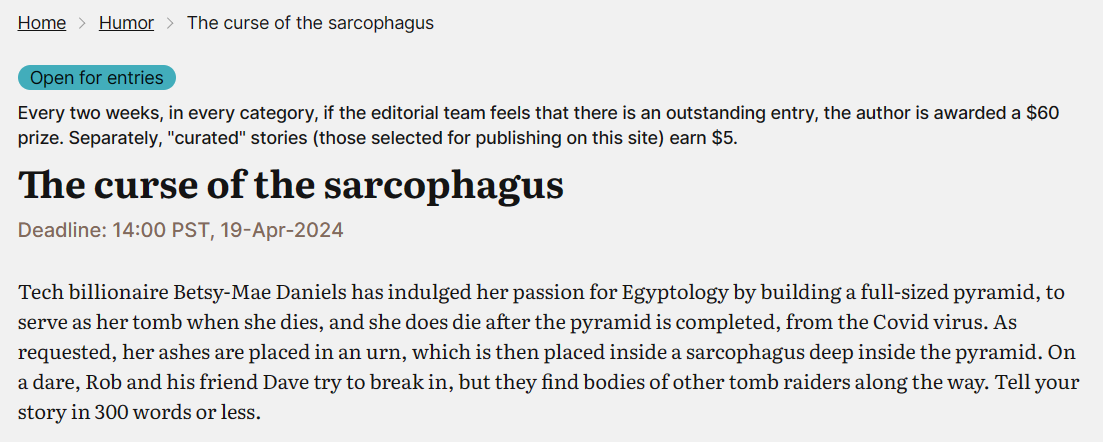
But the lure of a $5 prize was more than I could resist. 300 words isn’t much, and just setting up the story could use all 300 words. Fortunately, I noticed this as part of the rules.

I was relieved, but I was also stumped. I concepted and discarded about half a dozen story ideas that went absolutely nowhere. On top of that, they were very unfunny for stories that were supposed to be humorous. So, I just sat down and started writing. One hour later, a story that featured a fart reference, clever (allegedly) wordplay, and some dad jokes was completed and submitted. I don’t have an explanation for how I wrote it except that sometimes you just need to stop thinking and start writing. Hmm, maybe that’s why I get mostly rejections.
The biggest benefit to me was in the editing practice. In a 300-word micro-fiction story, every word is important. As I edited, I noticed all sorts of extraneous words I was able to remove that made reading the story cleaner. That allowed me to expand the story with more uproarious antics of tomb raiders Dave and Rob. I need to do that with all my writing, except without adding more Dave and Rob detail that would be out of place in my other stories that don’t involve those crazy guys.
I’ll try and share both the free-verse poem and my micro-fiction story when I figure out the best way to do so. But you don’t need to read my stuff that gets rejected. You need to write some of your own stuff, and maybe we can be rejection buddies someday.

 Jim Flanigan Looks at the World
One thought on “Rejection Means Someone Read Your Writing”
Comments are closed.